
Tracy Taylor has shared how her life was saved by her line manager after experiencing a sudden and life-threatening illness at home.
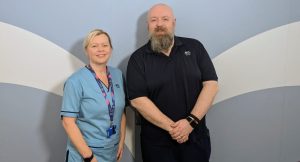 Tracy, who is 48 and from Glasgow, currently works as a psychological wellbeing practitioner in NHS 24’s Mental Health Hub in Cardonald. She has worked for the NHS for 30 years but has five years’ experience in her current role which involves promoting positive mental health to anyone contacting 111 for support, undertaking mental health assessments, and coaching colleagues.
On June 16, 2023, Tracy’s life took an unexpected and dramatic turn when she suffered a very serious and often fatal condition, a subarachnoid haemorrhage – an uncommon type of stroke caused by bleeding on the surface of the brain.
Tracy explains how she had no warning at all that her life was in danger:
“That day started totally normal. I was feeling fine, and I had no idea that I would suddenly become so unwell. While getting ready for a back shift at work, I suddenly experienced a thunderclap headache followed by blurred vision and vomiting.”
A thunderclap headache is a rare, sudden, and severe headache that can signal brain blood vessel problems or bleeding. Thunderclap headaches should be treated as an emergency and need immediate medical attention.
Tracy continues:
“I felt so ill that I tried to contact my husband Gordon at work but I was unable to reach him. And that’s the last thing I remember.”
After trying and failing to contact her husband, Tracy managed to get through to her line manager at NHS 24, although she does not remember the conversation. David McKissock, who is 37 and also from Glasgow, is a senior charge nurse with over 16 years of clinical experience. He immediately recognised that something was very wrong:
“Tracy actually rang me on my personal mobile that afternoon, which was not normal for her at all,” said David. “When we started speaking, she also did not sound like her usual self – there were notable differences in her speech, and she appeared really confused and vague. This raised a red flag for me as I knew it was likely that Tracy was at home alone, that she was potentially in a life-threatening situation, and she would need immediate help.”
David contacted fellow NHS colleagues in the Scottish Ambulance Service by dialling 999. Paramedics were soon dispatched to Tracy’s home, and she was rushed to Queen Elizabeth University Hospital (QEUH) for admission and assessment. The following day she was transferred to Edinburgh Royal Infirmary for emergency surgery, which involved small platinum coils being inserted into her brain to stop the bleed via a catheter.
Tracy recalls:
“I was in hospital for 3 and a half weeks, including spending time in both the Intensive Care and High Dependency Units due to risks of vasospasms, which are when the brain blood vessels narrow. My husband and family were with me daily, but my first memory of being hospital was about three weeks after I was first admitted.
“My recovery was challenging. I had memory issues, fatigue, and my sense of taste and smell changed. I had difficulty finding words when I was speaking, and I had issues with my tolerance levels. Initially, I was unable to walk far or even climb stairs. I was also unable to drive for a total of nine months. I relied heavily on my husband for most activities of daily living.”
Through engagement with occupational therapy, the brain injury team and neuroscience in QEUH, Tracy built up her strength and managed to go out for short walks supported by her husband, friends, and family.
Tracy continues:
“The support from these health and care services, as well as my loved ones has been amazing, and they have all helped to have a positive impact on my recovery. With their encouragement, I was able to return to work seven months after my illness on a phased return. I received full support from David, our team, and our colleagues within the occupational health and human resources departments. They have all been so understanding of my ongoing fatigue allowing me to ease myself gently back into the role, as well as allowing me to reduce my working hours.”
Tracy’s health is being checked regularly as she has another small aneurysm in her brain. However, due to its size it is not considered life-threatening and will not need treatment unless it changes or grows.
Tracy’s outlook remains positive:
“If David had not contacted 999, I am sure I would not be here today. I am eternally grateful to him for recognising the urgency of my situation but also for being an all-round great manager who genuinely cares about not only his colleagues, but the patients who we deal with every single day.
“I continue to have issues with fatigue, memory, taste and smell. However, I am so relieved and happy to be back at work and able to function in a job I find extremely rewarding.
“My advice to anyone going through a similar recovery to mine, would be to accept the support. Take one day at a time, rest when you need to, and know your limits. For good mental well-being – exercising gently and trying to have a healthy diet and get enough good sleep can really help to build up your activity and confidence.
“My number one tip to everyone though, is make every single day count. Live your life to the fullest.”
Dr Ron Cook, NHS 24’s Medical Director said:
“Tracy’s story is a powerful reminder of the importance of quick thinking and immediate action in medical emergencies. At NHS 24, we are committed to providing the highest level of care and support to not only our patients, but every member of staff who works in our team. David’s swift response and the coordinated efforts of our colleagues in the Scottish Ambulance Service and the hospitals involved, exemplify the dedication and professionalism of our healthcare teams across Scotland. We are incredibly grateful for the positive outcome in Tracy’s case and continue to wish her well in all aspects of her recovery.”